I Gave Qwen 3.8 Max One Minecraft Goal

One model. One sentence. One natural world.
The pickaxe appeared in cycle 8.
Qwen 3.8 Max chose the intermediate steps, placed a crafting table, crafted the target item, and still held it at the end of the recorded run.
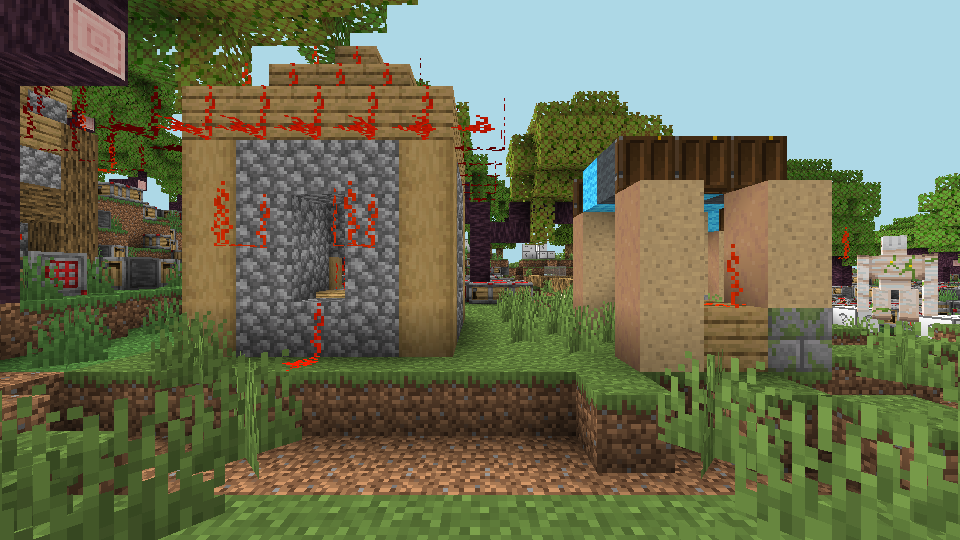
Initial first-person capture. The red and blue pixels are a known Prismarine Viewer texture-version caveat, not evidence of placed blocks.
The Minecraft objective succeeded. The 20-cycle run did not. Both statements come from the same artifact bundle: the wooden pickaxe was verified at cycle 8, while the provider request that would have started cycle 19 timed out.
Alibaba Cloud currently lists qwen3.8-max-preview as a
preview model available through Token Plan.
Its OpenAI-compatible chat documentation gives it a default reasoning effort of
xhigh,
and the model appears in the official
function-calling support list.
That made it a useful candidate for a tool-driven Minecraft run where text alone
cannot count as progress.
The experiment
I kept the setup deliberately small. There was no model comparison and no staged progress fixture.
The complete actor-facing goal
Starting from an empty inventory in this fresh natural world, craft and retain one wooden pickaxe. Choose the intermediate steps yourself. Count only inventory or world-state changes as progress.
The scenario generated a fresh natural world and validated a safe spawn. It did not place logs, a crafting table, or the target item. Qwen saw the available Minecraft action cards and current observations. The runtime executed structured tool calls through Mineflayer and wrote an evidence artifact for every attempt.
The shortest path was eight cycles
The useful chain was straightforward:
| Cycle | Selected action | Evidence-backed result |
|---|---|---|
| 1 | collect_logs | log inventory increased |
| 2 | craftPlanksAndSticks | planks and sticks crafted |
| 4 | craftCraftingTable | crafting table crafted |
| 7 | placeCraftingTable | table verified at (10, 111, -11) |
| 8 | craftWoodenPickaxe | wooden pickaxe count changed from 0 to 1 |
Cycle 8 is the key row. Its craft_with_table result says
wooden_pickaxe increased from zero to one, and the postcondition passed. The
final consolidated inventory still contained one wooden pickaxe. A later observe
record also showed it as the held item.
The actor was not given that five-step sequence in the goal. It had to select the intermediate actions from the runtime's exposed action surface.
What happened across all recorded cycles
Eleven of eighteen completed cycles produced verified progress. One more produced a real but incomplete world mutation: the shelter action placed four blocks, while its own verifier correctly refused to call the shelter complete.
The five no-progress cycles were mostly post-goal behavior: one observation, three equipment checks, and one memory write. The blocked cycle was a cobblestone mining attempt that timed out.
This split matters. If I looked only at the top-level status, I would call the run a failure. If I looked only at the target item, I would hide the provider timeout and the ten cycles spent after success. The evidence supports a narrower reading:
- Qwen completed this specific material objective.
- The harness failed to stop when the target predicate became true.
- The longer lane later ended on a provider timeout.
The screenshots are useful because they are weak
Initial frame, cycle 0 This establishes the visual context. Version-skewed textures create red and blue artifacts, so the image cannot identify every visible block reliably.

Final frame, after cycle 18 The camera points into nearby blocks. It is too obstructed to prove the final inventory or even show the pickaxe clearly.
The final image is a useful warning for visual agent reports. It would be tempting to treat a disappointing screenshot as a failed task. Here the pixels answer only one question: what did this camera see? The item claim comes from the cycle 8 inventory delta, the later held-item observation, and the final consolidated state.
| Claim | Runtime authority |
|---|---|
| Pickaxe crafted | cycle 8 craft_with_table, count 0 → 1 |
| Pickaxe retained | final consolidated inventory plus held-item observation |
| Crafting table placed | cycle 7 place_block and world position evidence |
| Shelter incomplete | cycle 15 local pattern verifier |
| Main run stopped | top-level provider timeout after 18 cycles |
| Visual appearance | two capture artifacts, used only for review |
The final state
Consolidated inventory
- wooden pickaxex1
- oak planksx4
- white bedx1
- sticksx2
- oak logsx2
World state
The crafting table remained known at (10, 111, -11). A later
shelter attempt placed four oak-plank blocks, but the verifier measured zero
roof coverage and kept the shelter status at progressing.
After completing the pickaxe, Qwen did not simply stop. It observed, equipped the pickaxe several times, recorded a memory, attempted to mine cobblestone, began a small shelter, gathered more logs, and crafted more planks.
That behavior is not part of the requested success criterion. It reveals a harness design issue: the run had a fixed 20-cycle budget but no early-stop predicate tied to the natural-language target. Ten post-goal cycles added cost and introduced new failure opportunities without strengthening the original result.
Provider usage and the timeout
The main lane was preflighted for at most 30 requests and 1.2 million total tokens. It stopped at 23 requests and 570,145 total tokens.
Main-run token accounting
A separate one-cycle canary used one request and 17,420 tokens. It confirmed the exact model name, raw reasoning content, provider-reported usage, and no retry. The main run recorded no fallback judgments and no invalid model outputs.
The final request timed out. The runtime did not retry it or silently switch to
another model. It preserved the 18 completed cycles and wrote
runtime_status: failed with provider_error: Alibaba Model Studio request timed out.
Billing caveat: this run was approved against a local request/token ceiling, but that policy did not establish whether the preview allocation was billable. Qwen 3.8 Max is a preview, Token Plan-only offering at the time of writing. Check the current Model Studio plan terms before reproducing the run.
What I would test next
The next experiment does not need a larger benchmark. It needs a cleaner stop condition:
Stop the lane as soon as runtime evidence confirms wooden_pickaxe >= 1.
On this run that would have ended the experiment at cycle 8. It would remove ten post-goal cycles, reduce provider usage, and make “cycles to verified target” unambiguous.
A harder follow-up goal, such as crafting and retaining a stone pickaxe, becomes useful only after that measurement boundary is in place. Otherwise the result mixes competence with whatever the actor chooses to do after it has already finished.
Limits of this result
- One model, one seed, one natural-language goal, one run.
- No Qwen 3.7, OpenAI, or Gemini comparator.
- No leaderboard or general model-quality claim.
- Eighteen completed cycles out of twenty planned.
- A provider timeout after the target was reached.
- Two review captures, both with visual limitations.
- No evidence for social behavior or long-run autonomy.
The result is still worth sharing. Qwen 3.8 Max turned a short natural-language goal into a verified Minecraft material chain and reached the target in eight cycles. The same run also exposed the next measurement problem clearly: once the world says the goal is complete, the benchmark should listen.